
Mixed tank configurations
The project covered both vertical and horizontal tanks.
EPC plans and installs automatic tank gauging (ATG) systems in Pakistan for petrol stations, diesel storage and industrial tanks. Monitor fuel level, calculated volume, water and temperature with a system matched to your tank, product and reporting needs.
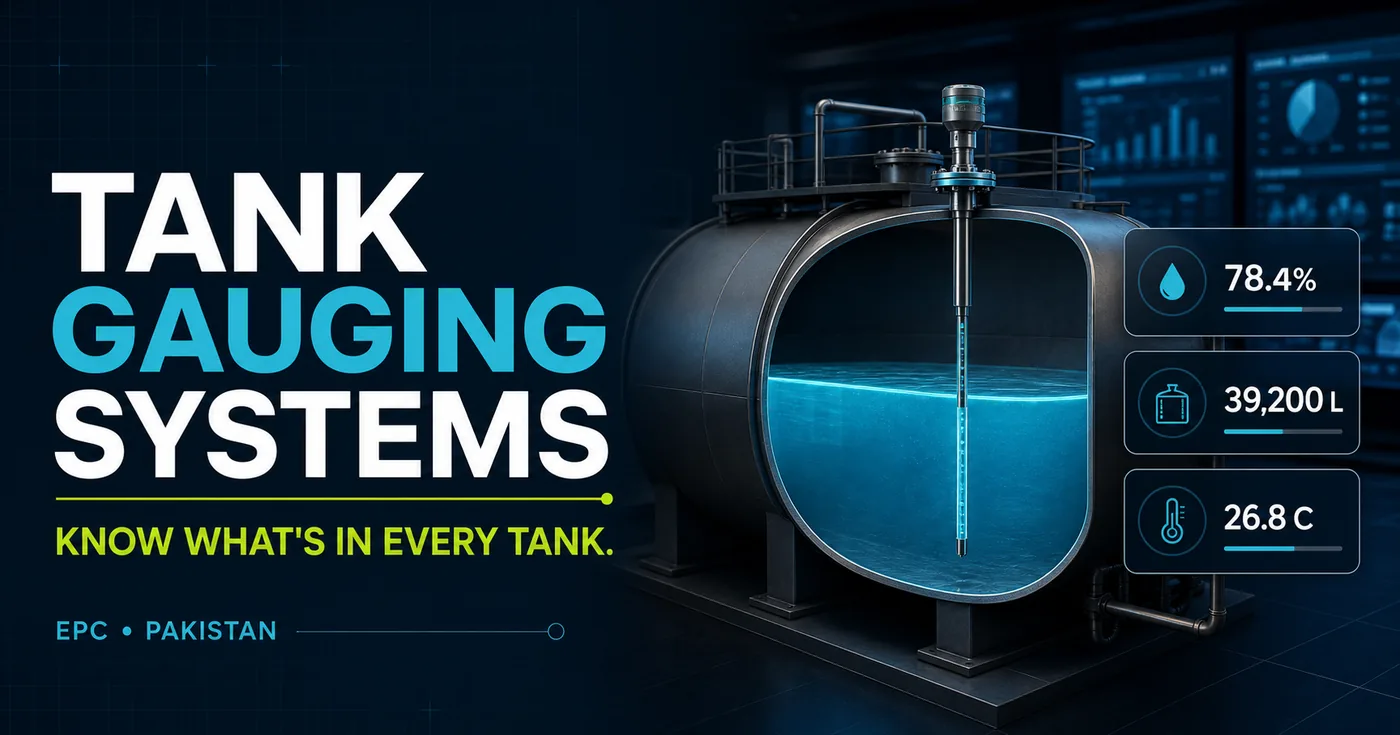
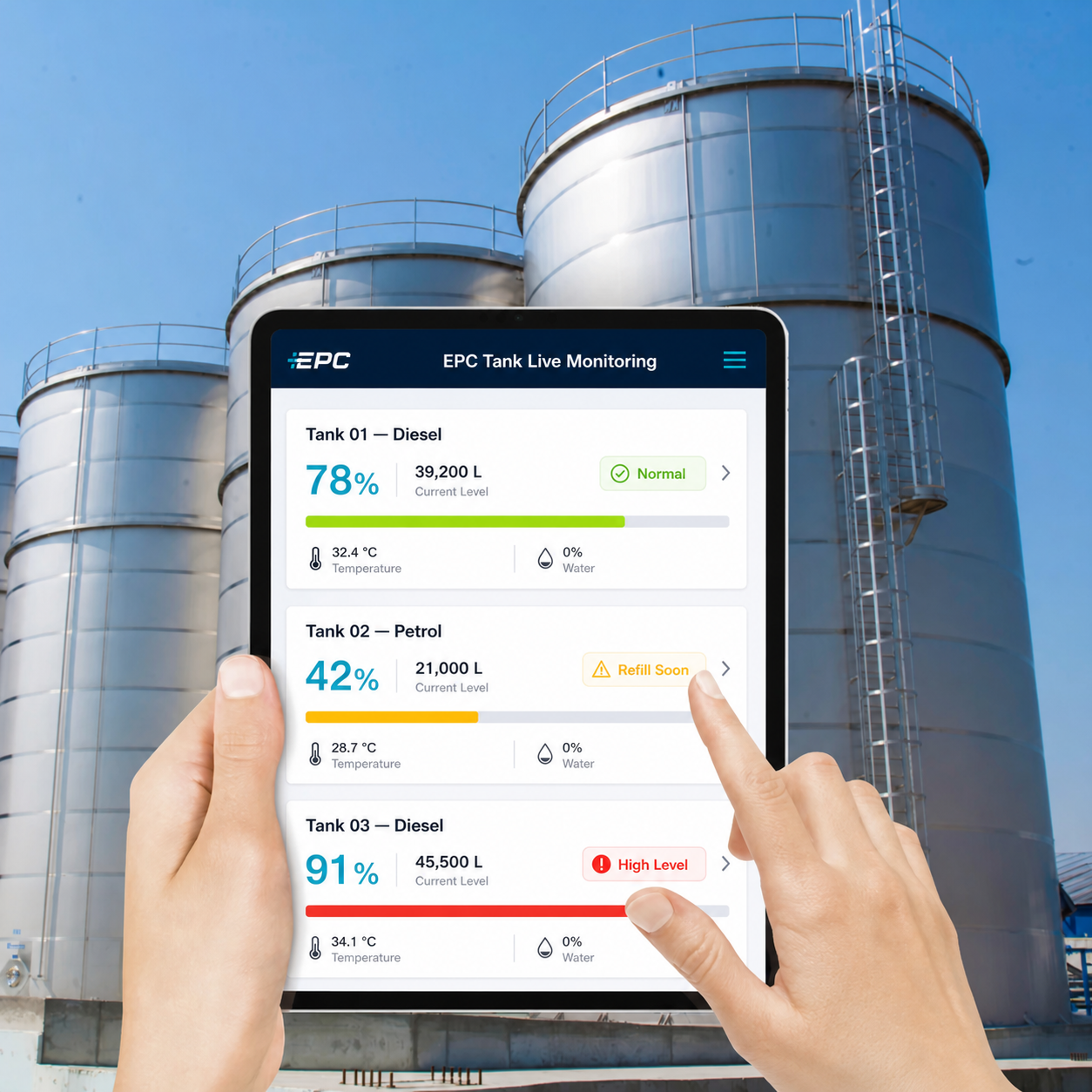
An automatic tank gauging system, also called an ATG system or automatic tank gauge system, uses in-tank probes and a controller to monitor stored liquid. Compatible equipment reports product level, water and temperature; tank calibration data is used to calculate volume. Operators can review inventory and configured alerts without relying only on manual dip readings.
EPC plans each solution around tank geometry, stored product, operating environment, communications and the level of reporting your team actually needs.
Measurement capability depends on probe technology, tank type and the approved system design.
Continuous liquid height measurement helps replace irregular manual dip readings.
Tank calibration data converts measured level into practical inventory volume.
Compatible probes can identify water at the bottom of fuel storage tanks.
Temperature data supports inventory review and early identification of abnormal conditions.
An automatic tank gauge uses a level sensor or probe installed in the storage tank. The measurement is sent through a suitable communication interface to a local console, controller or cloud-connected monitoring platform. Tank geometry and calibration data help the software calculate usable inventory.
A compatible probe continuously senses product level and other configured tank conditions.
Readings move to the control unit through a wired or suitable wireless communication route.
The monitoring software uses the approved tank chart to display level, volume and available capacity.
Operators review live inventory, delivery events, alarms and historical movement from one interface.
One connected view for inventory, delivery events, exceptions and historical tank movement.
View product level, volume, ullage, water level and temperature from one clear screen.
Record tank inventory before, during and after deliveries for faster reconciliation.
Get early warning for high level, low stock, water ingress and abnormal temperature.
Review movements, deliveries and alarm events with time-stamped operational records.
Supervise single or multiple sites without waiting for manual dip readings.
Connect monitoring data with compatible automation, control and reporting workflows.
EPC developed an automatic tank gauging (ATG) system for a confidential client's vertical and horizontal storage tanks. The project included online tank-level monitoring and loading/draining status visibility.
The project covered both vertical and horizontal tanks.
Tank levels could be viewed online.
The system displayed loading/draining status alongside level information.
The delivered system provided online visibility of tank levels and loading/draining status across the project's tanks. This summary describes the monitoring functions delivered; it does not claim automated control of loading or draining operations.
Client identity, project access details, and operational readings are withheld for confidentiality.
From the measuring point inside the tank to the information your operations team uses—each layer has a clear role.
Measures product level, water and temperature inside the storage tank.
Collects probe readings, applies tank data and manages local alarms.
Transfers site information through the selected network or integration route.
Organizes inventory, events and historical records across one or many sites.
Presents live status, alarms and decision-ready information to your team.
A reliable automatic tank gauging system starts with the tank and operating requirement—not a generic equipment list. EPC reviews the storage arrangement, product, measurement objective, site access and reporting needs before recommending a practical system architecture.
Tank quantity, dimensions or capacity, stored product, aboveground or underground installation, existing instruments, site location and local or remote monitoring requirements.
Underground, aboveground, horizontal and vertical tanks require different installation and calibration considerations.
Diesel, petrol and industrial liquids influence probe compatibility, materials and the measurements required from the system.
Define whether the fuel tank monitoring system must report product level, calculated volume, water, temperature, ullage or delivery movement.
Choose a local tank display, remote dashboard or multi-site inventory view according to operational responsibility and connectivity.
High level, low stock, water ingress and unusual movement alerts should match the decisions your operators need to make.
Review cabling, hazardous-area requirements, controller location and connections with compatible automation or reporting systems.
For sites where stock accuracy, safety and timely replenishment matter—from a single generator tank to a multi-location fuel network.
We review tank details, product, access, current equipment and monitoring goals.
EPC selects a suitable measurement, communication and reporting architecture.
Equipment is installed, configured and checked against the agreed scope.
Operators receive system guidance, documentation and a clear support route.
A useful quotation starts with your tank list and the information you need from the system. A single-tank local display and a multi-site remote monitoring project have different equipment and installation requirements.
Before selecting equipment, request the proposed model datasheet, stated accuracy, applicable approvals and written inclusions and exclusions. Final suitability should be confirmed against your actual site requirements.
Need a project-specific answer? Send EPC your tank list and site details.
Depending on the selected probe and system design, it can measure product level, calculated volume, water level, temperature and available tank capacity.
Yes. EPC can review existing tanks, dimensions, products, site conditions and current instruments to recommend a practical retrofit or new installation route.
Remote access can be included where the site has suitable communications and the selected equipment supports central monitoring.
Share the number of tanks, dimensions or capacity, stored product, site location, current level method and whether local or remote monitoring is required.
The quotation depends on tank quantity, probe specification, controller capacity, installation access, cabling, calibration data and local or remote reporting. Ask for an itemised equipment, installation and software scope so that offers can be compared on the same basis.
Manual dipping gives a reading when an operator checks the tank. An automatic tank gauging system provides recurring measurements and, where configured, recorded inventory, delivery events and alarms. Measurement quality still depends on suitable equipment, installation and accurate tank calibration data.
Practical guidance for fuel storage, inventory monitoring and system planning in Pakistan.
ATG components, measurements, applications and selection basics.
GUIDE 02Compare reading frequency, safety, records, cost and operational use.
GUIDE 03Understand the equipment, installation and software factors behind cost.
GUIDE 04Manual and automatic detection methods, alarms and response planning.
Share tank quantity, dimensions or capacity, stored product, site location and the monitoring outcome you need.